the mother-in-law's house
Die, My LoveThe mother-in-law's house is a big block of solid concrete with a view of the open fields of dry pasture and corn beyond a row of vegetable gardens. The paved path leading to it is dirty, and the air is tainted with carcinogenic smoke, because someone nearby is burning copper cables to resell. The moles dig deep holes in what is also their land, turning it into a minefield. The Father-in-Law used to say definitive action needed to be taken by putting gas bottles at the entrance to their homes: the Shoah of moles. This is the house of the Narrator's in-laws, the home of the Mother-in-Law and the Father-in-Law, and after the latter's death, it becomes the stage for the Mother-in-Law's unravelling widowhood and for the Narrator's most violent act.
The House and Its Setting
The house is a solid concrete block, a structure of permanence and weight, set against the open fields of dry pasture and corn beyond a row of vegetable gardens. The paved path leading to it is dirty, and the air is tainted with carcinogenic smoke, because someone nearby is burning copper cables to resell. The moles dig deep holes in what is also their land, turning it into a minefield. The Father-in-Law used to say definitive action needed to be taken by putting gas bottles at the entrance to their homes: the Shoah of moles. This is the house of the Narrator's in-laws, the home of the Mother-in-Law and the Father-in-Law, and after the latter's death, it becomes the stage for the Mother-in-Law's unravelling widowhood and for the Narrator's most violent act.
The Widow's Grief
After the Father-in-Law's death, the Mother-in-Law carries on cooking for two, changing the pillowcases, and mending his underwear that was torn at the crotch. In the morning, still awake from the night before, the Narrator goes by with the buggy and sees her sitting there, in a daze, her head inside a bell. She lives in her body as though it were an infested house, as if she had to tiptoe through it trying not to touch the floor. The only time she is at peace, she says, is in her sleep, when the spirit scatters. But she has serious difficulty sleeping and used to sleep-walk. Once she strolled through the village in a nightie shouting Fire! Another time she used a shoe as a phone and conversed with God by means of it. This was when she wasn't doing the hoovering at four in the morning. Her breakfast consists of white bread that has been left out in the kitchen for days. She doesn't check the expiry date on the medication she started taking the day of the funeral. She doesn't scare away the flies or remove the eggs they've laid in the jar of homemade chestnut jam. She watches the fingers bringing the bread to her mouth as though they belonged to someone else and she chokes, because time doesn't pass for the person who's left behind. It's a perpetual limbo. Like a wet shirt, clammy against the body, something that doesn't go away, that won't come unstuck.
The Narrator's Night Visit
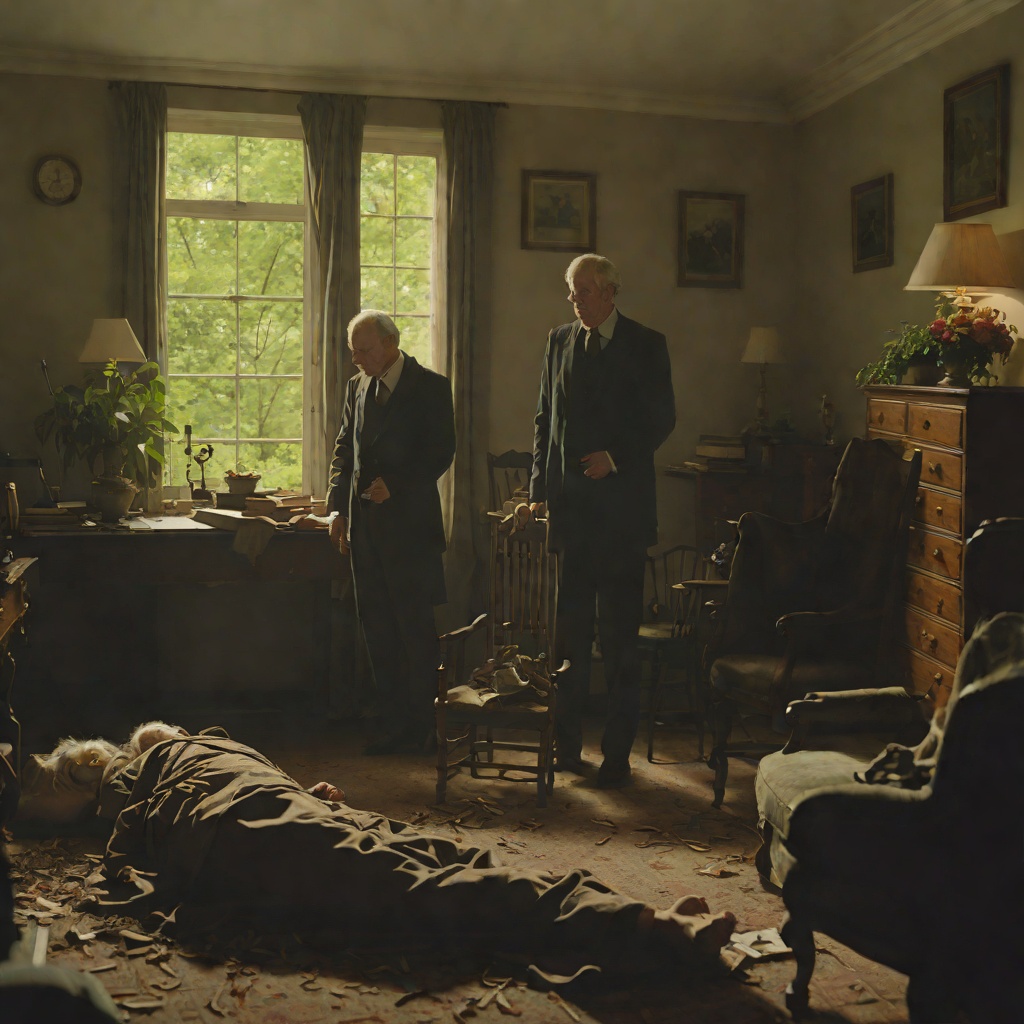
One night, driven mad by Bloody's cry, eeeeee, eeeeee, echoing throughout the house, the Narrator gets up, grabs the small torch from the tool drawer and goes into the garage. She rummages through everything. Layers of filth have accumulated on the pieces of wood, on the unused furniture and the swivel chairs; only the telescope seems clean, sheathed as it is in clear plastic. She knows she'd regret it if she left it at that. She goes outside, leaving the front door open. The cold air would chill the house in no time. In wellies and half-naked, she goes to her mother-in-law's place. She isn't out in the countryside, she is in a spaghetti western. She finds the rabbit-paw keyring hidden in the flowerpot next to her front door and lets herself in. If her father-in-law had been alive, he'd have fired, no matter the direction, just for the pleasure of pulling the trigger. The pile of ironed shirts, the books organised on the shelves, nothing gives the impression that someone had recently died. She goes up the suspended staircase, holding onto the ropes on either side. Her mother-in-law is asleep, doped up. She is a plank, her eyes covered by a mask, two pieces of cotton-wool in her ears; a flat-chested, sexless body like a table wrapped up in sheets. Next to her are a piano and a Japanese drawing of a small island. Her bedroom is snow. She doesn't even blink when the Narrator makes a noise tripping over the long laces of her shoes. The Narrator lights a candle and looks at the piano again, feeling an urge to play a note. She searches. Some people need to be able to see the ocean, but she needs to be able to see a firearm, even if it's motionless, dirty and unloaded.
The Shotgun and the Killing of Bloody
When the Narrator's husband opens one eye, he finds her aiming at him. He is so scared he can't say a word. Kill him, she says. What, kill who? Eeeeee, eeeeee. Kill the dog. Why would I kill him? Because he's suffering. So what? Leave him alone. You can't be serious. Eeee, eeee. We'll call the vet tomorrow, he says, and rolls over onto his side, his arse facing her. Call who? Go on, kill him now, she says, out of her mind. But he doesn't even flinch, in fact he lets out a snore almost as loud as Bloody's whimpers. She stays there, watching him sleep, astonished by his relentless cowardice. Shotgun in hand, she goes from room to room until she reaches the corner of the kitchen where, all twisted on a filthy rag, Bloody is sobbing with pain. She aims. Her brain goes blank. She feels like an Israeli soldier and suddenly, in her mind, she hears the order. Fire! Fire, you bastard! And there, for the first time in her life, she pulls the trigger.
The House as a Space of Death and Memory
The mother-in-law's house is a space where death and memory are inseparable. The Father-in-Law's presence lingers in the pile of ironed shirts and the books organised on the shelves, nothing giving the impression that someone had recently died. The Mother-in-Law's grief is a perpetual limbo, a wet shirt clammy against the body, something that doesn't go away, that won't come unstuck. The house itself, a big block of solid concrete, is a mausoleum of the Father-in-Law's life, from his pedantry and his monologues from the head of the table to his laughter from atop the tractor he drove, all locked in a pinewood coffin. The house is also the site of the Narrator's most violent act, the killing of Bloody, an act that she commits with the Father-in-Law's shotgun, a firearm that she needs to be able to see, even if it's motionless, dirty and unloaded. The house, with its concrete walls and its view of the open fields, is a space where the living and the dead are indistinguishable, where the Mother-in-Law's sleepwalking and the Narrator's madness converge, and where the family's darkest secrets and most brutal acts are housed.